How to make a bouyon riddim with drum loops and stems
Bouyon, which comes from Dominica, is recognisable by its fast tempo and very present drums: a driving kick, snares and toms that push each phrase, cowbells and percussion that keep the groove moving. This guide gives a concrete method to build a riddim from drum loops supplied with their stems, using Bouyon Pressure Vol. 2 as the example.
- Bouyon Pressure Vol. 24 bars of each loop in the kit
1. Pick the tempo
The loops in the kit run from 152 to 160 BPM. Set your project to the exact tempo of the loop you pick: at 160 BPM, 8 bars of 4/4 last 12.0 s; if the loop doesn’t fill exactly 8 bars in your DAW, the project tempo is off.
| Loop | BPM | Length of 8 bars |
|---|---|---|
| Ti Nen | 152 | 12.63 s |
| Pwadibwa | 153 | 12.55 s |
| Mannyok | 154 | 12.47 s |
| Papay | 155 | 12.39 s |
| Ziyanm | 155 | 12.39 s |
| Fouyapen | 156 | 12.31 s |
| Malanga | 157 | 12.23 s |
| Jiwomon | 158 | 12.15 s |
| Bwa Bande | 160 | 12.00 s |
| Dashin | 160 | 12.00 s |
| Gonmbo | 160 | 12.00 s |
| Poyo | 160 | 12.00 s |
2. Lay down the full groove, then take it apart
Start with the FULL file to write bass and chords over a finished groove. Once the idea works, swap it for the stems (KICK, SNARE, HH, TOM, COWBELL, PERCS…): you can thin out a verse by muting the toms, keep only kick and cowbell for an intro, or save the crashes for section changes.
3. Add one-shots
- Kick: if your bass takes a lot of room, try another kick from the kit rather than over-EQing.
- Snares and toms: program fills on the last bar of an 8-bar block to announce the next section.
- Percussion: cowbell, conga and shaker one-shots let you vary the pattern between sections without changing loops.
4. The bass
The 10 sub bass one-shots are not labelled by note: load them into a sampler, tune them by ear or with a tuner to your song’s root, then play the line in MIDI. Line up the main notes with the kick to keep the low end readable.
5. Arrange in 8-bar blocks
Every loop is 8 bars long: build your riddim in blocks of 8 or 16 (intro, verse, chorus, bridge). Change loops or stem combinations at each block and use crashes to mark a new section.
6. Mix the drums
- High-pass the hi-hats, shakers and cowbells to leave room for the kick and bass.
- Route the stems to a drum bus: light bus compression glues the parts together.
- Check at low volume and on a phone: in bouyon, kick and snare must stay audible everywhere.
7. Export and release
Export your riddim as WAV. The kit license allows commercial releases of tracks made with these sounds; only redistributing the sounds themselves is prohibited (full license).
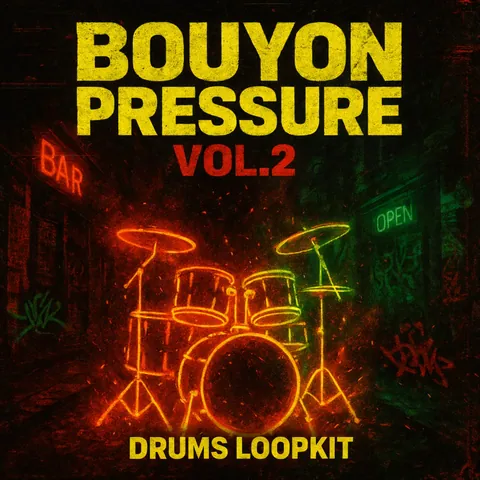
The loops used in this guide
12 bouyon loops with 95 stems and 134 one-shots in 24-bit WAV.